



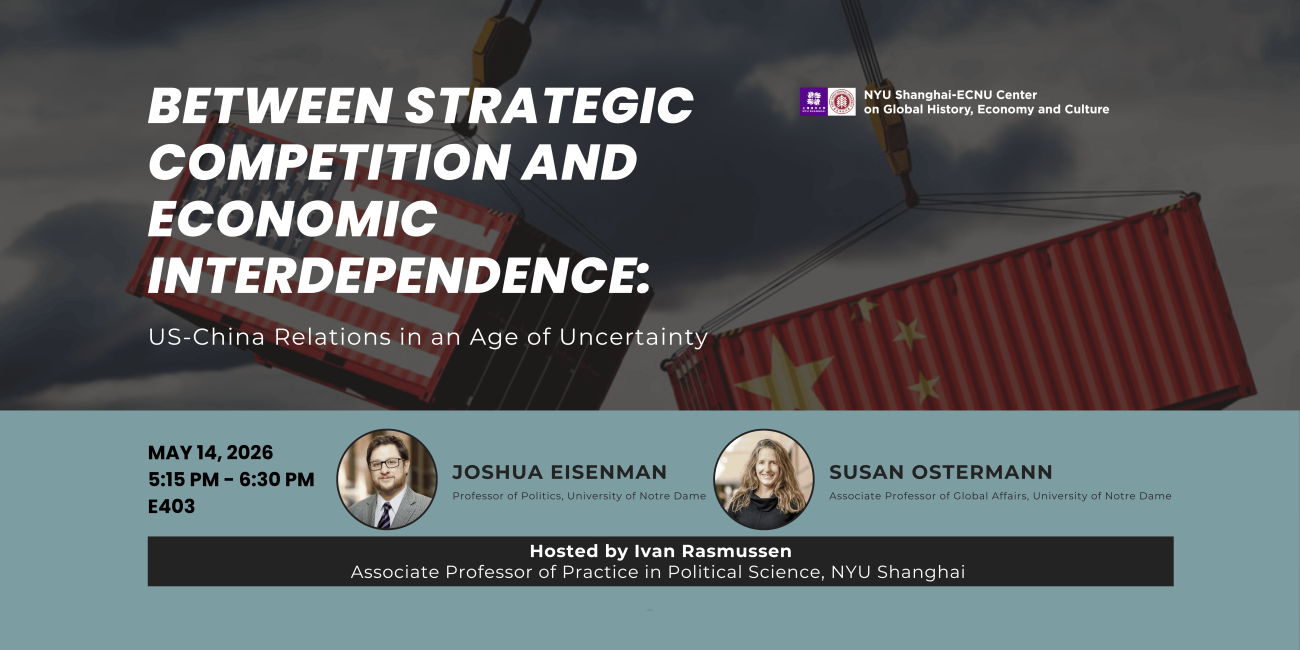
Ivan Rasmussen (Associate Professor of Practice in Political Science, NYU Shanghai)
Abstract:
The US-China relationship is now being strained on multiple fronts. The two countries are navigating strategic competition amid resilient economic interdependence. Professor Eisenman will examine how shifting US priorities and geopolitical frictions from Iran to Ukraine are reshaping bilateral relations.
Biography:
Joshua Eisenman is professor of politics at the University of Notre Dame and Senior Fellow for China Studies at the American Foreign Policy Council in Washington, DC. Author of five books and numerous articles, his 2025 research included scores of interviews in Czechia, Morocco, Singapore, Malaysia, and Colombia, examining how small powers navigate relations with China. Eisenman has been a visiting professor at Peking University (2016), Fudan University (2017), and Shanghai International Studies University (2023). Between 2003-2005 he served as a policy analyst for the US-China Economic and Security Review Commission. Eisenman holds a PhD from UCLA and an MA from Johns Hopkins SAIS including a year at the Hopkins-Nanjing Center. He first came to China in 1998 as an exchange student studying Chinese at Capital Normal University.
Susan L. Ostermann is associate professor of global affairs and political science at the Keough School of Global Affairs at the University of Notre Dame. Employing both quantitative and qualitative methodology, Ostermann seeks to understand the relationship between state capacity, coercion and law. Why do we sometimes see compliance with regulations in places where the state is coercively weak and actors, be they individuals or organizations, have strong incentives to break the law? Her book "Capacity beyond Coercion: Regulatory Pragmatism and Compliance along the India-Nepal Border" (Oxford University Press) develops the concept of regulatory pragmatism to explain variation in strategies used by both the Nepali and Indian states to secure compliance with conservation, education and child labor regulations under challenging conditions. While Professor Ostermann’s research focuses mainly on regulatory compliance in South Asia, she is broadly interested in understanding laws and norms and how they change and interact. Towards this end, she has published papers on inter-caste marriage and the role of skin color in Indian politics. She has also published work on the historical roots of conservatism in Indian political thought, the development and expansion of the Indian Election Commission, variation in sex-ratios throughout the subcontinent, the Indian bureaucracy, state capacity in South Asia and the 2014 Indian general election. Ostermann’s work has been published in Law & Society Review, Governance, Asian Survey, Studies in Comparative International Development, the Journal of Race, Ethnicity and Politics, Studies in Indian Politics and Law & Policy. Ostermann holds a Ph.D. from the Travers Department of Political Science at the University of California, Berkeley. She also holds a law degree from Stanford Law School and worked for several years as a practicing litigator, focusing on class actions and intellectual property disputes.
Susan Ostermann (Associate Professor of Global Affairs, University of Notre Dame)